Are Your Cats Fighting? Top 5 Tips Based on Real Experiences

Updated: Sep 24
*As an Amazon Associate I earn from qualifying purchases at no cost to you.

5 Tips for Fighting Cats:
When your bonded cats start fighting, it's usually proceeded by a storm of human emotions and I've experienced them all: confusion, shock, panic, stress, horror, dismay, heartache - and don't get me started on the insomnia! To sum it up, I can say that I was well and truly devastated by the ordeal, and I know it's something that only other cat parents will relate to.
I originally started this blog to document my experience, as hinted in the title. It quickly became a resource for anyone wanting to understand inter-cat aggression, why it happens and how to manage it. I've included below some of my most popular articles for reference, and if you've already read them, the tips I'm about to share will sound very familiar.
It's nothing I haven't said before in one roundabout way or another, but I want to summarise a few important - and often underrated - points. The focus here is on cats that were previously bonded, but you can apply it to almost any situation.
Recommended reading:

Litter Tray Hygiene
I know, you've heard it all before but stay with me....
Maintaining litterbox hygiene is always important, even more so where aggression is present. A lot of parents are quick to defend themselves with comments like: "I scoop every day!" or "My cats don't have any problems with the litter tray."
Well, neither did mine. Just because your cats aren't fighting over or around toilet areas doesn't mean it's not causing a problem - and it has little to do with scooping.
Scooping alone is not sufficient to keep a litter tray clean; you should be doing a full wash and litter change every 1-2 weeks. There's a reason some trays come with high "anti-splash" sides, and that's because pee has a tendency to splatter.
I'm sure I don't have to point out too that cats are in no rush to wash their paws after toileting. This means that damp or soiled litter is trampled around the house, particularly if you have a longhair with big hairy paws (I'm looking at you, Drax!).
 Double Layer Cat Litter Mat collects loose litter for easy shaking into a bin. Made from flexible and comfortable EVA material with a waterproof bottom. Multiple sizes available. |
Not only is cat pee one of the toughest odours to remove, but cats will pick up on the pheromones in urine - and therein lies the problem. It was Simba that alerted me to this, as I noticed him sniffing around the floor pulling the famous "stink face" where a cat curls back its upper lip, essentially tasting scents.
If you're not familiar with the flehmen response, performed when a cat detects another cat's pheromones, this post is essential reading: What Are Cat Pheromones and How Do They Work?
How is this relevant to aggression?
As any cat parent should know, urine has a very important role in territory marking. Therefore, if one cat can smell the other cat's pee stains around the house - even if it's residue from the litter tray itself - it can cause some serious misunderstandings and contribute to feelings of insecurity.

To emphasise the importance of this, there was an instant improvement to my cats' behaviour after I disinfected the floors - notably Simba, who was the one being bullied. It wasn't a solution in itself, but he was 50% less scared and reactive to Drax. Doing this will also remove any foreign smells brought in from outside on human feet.
In a way, I'm lucky that Simba is an obsessively sniffy cat or else it never would have occurred to me. And for the record, I couldn't see or smell a drop of pee prior to cleaning!
Don't wait for your cats to show signs that the litter tray is causing a problem - get the marigolds out and start scrubbing with a pet-safe disinfectant like Fresh Pet Cleaner and Deodoriser. Worst-case scenario, there's no change in behaviour and you can rule it out as a contributing factor. Process of elimination is the best approach you can take with animals that can't simply tell you what's wrong.
Note that the above doesn't apply to urine spraying, which is a separate issue. If your cat is deliberately toileting outside the litter tray, refer to this dedicated post: Why Do Cats Urine Spray in the House and How to Stop It?
For further advice on the best types of litter trays to minimise litter tracking and multi-cat suitability, this article by PawPicks covers some in-depth recommendations: Best Cat Litter Box 2026: Self-Cleaning, Top-Entry & Budget Ranked

Territory and Space
Let's be real, expecting cats that don't like or care for each other to share a household is a huge ask. How would you feel if you had a family member or housemate that enjoyed kicking your arse for no reason whatsoever?
Also, in case I hadn't already mentioned it a hundred times, our feline friends are notoriously territorial creatures. The least you can do is provide enough space so they can avoid each other by way of climbing opportunities, shelves and resting spots. A couple of cat trees in your living room isn't going to cut it.
 Feandrea Large Cat Tree Tower provides height, space and enrichment. Stands at 206cm tall and features 5 levels including 2 perches, 2 condos, 1 hammock and 14 scratching zones. |
I've heard of cats using everything from the top of fridges to doorframes to escape an aggressive housemate - you'd be amazed at the places they can reach when desperation kicks in. Ideally, they should have a "safe place" to retreat to in every accessible room.
In cramped living areas or flats, compact floor-to-ceiling cat trees and wall-mounted shelving make great use of vertical space. PELUOMOZ Cat Wall Furniture Set includes a bed, hammock, scratch post, shelf and bridge to provide your cat with a comprehensive sleeping, climbing, jumping and play area.
If you're on a budget, you can adapt furniture that you already have: a chest of drawers, wardrobe or desk can all be made inviting with a basket or blanket. Even rearranging furniture by placing a chair or sofa in front of a window creates an engaging chill out zone where cats can observe the outdoors. The more time they spend climbing, exploring and crowning themselves king or queen of your wardrobe, the less chance there is of explosive encounters!
If your cats are indoor only, an outside enclosure or catio provides extra space and stimulation to help prevent boredom. Boredom can lead to stress, which in turn contributes to aggressive behaviour. Omlet has some great options for gardens and balconies.

Introducing Cats
I've spoken to at least one cat parent who, understandably, thought it'd be a good idea to get their older cat a new kitten to play with after it lost its companion. Most owners jump into a decision like this far too soon, since the existing cat has already experienced a huge change to its routine as it adjusts to life without its friend. Throwing another cat into the mix is a potential recipe for disaster, and there's every chance that your well-intentioned gesture will backfire.
You'll never be able to replicate the bond that your cat had with its previous companion. There are exceptions to this rule for cats with the right personality or temperament, but you shouldn't consider it to be the norm. As was the case with my acquaintance, who quickly learned that their older cat was more interested in bullying the new kitten. Furthermore, the additional stress eventually led to the cat attacking its owners.
 Beaphar CatComfort Excellence Calming Diffuser contains a copy of the feline facial pheromone to help reduce stress-related behaviours; and the maternal appeasing pheromone to promote bonding and harmony in multi-cat households. |
Would the introduction have gone smoother if the cat hadn't been subjected to so many changes all at once? It's entirely possible, but we also have to question whether a young energetic kitten is the best choice of companion for an older cat. I've made this mistake more than once over the years, and it's never without some level of conflict.
This is more of a forewarning for parents considering getting a new playmate for their existing cat, especially if it's following other major lifestyle changes: moving house, a new baby or any kind of upheaval. Cats are extremely change averse, and if you do make the decision to bring a new pet into the household, a gradual introduction will be much appreciated by any resident kitties!
Related post: How I Successfully Reintroduced Cats After Fighting

Contacting a Professional
There's no one better suited to advise on behavioural problems than someone who specialises in the subject, and you don't need to wait until you've exhausted every other option. The sooner you take steps to resolve the issue, the better the chance of success.
That can include doing your own research, even if it's following some of the advice and suggestions made here. Depending on your situation, you might be able to resolve things without intervention - in which case, congratulations!
It is possible - I'm living proof - but it may be easier with some outside help. The reason I didn't consult a behaviourist was because having an unfamiliar person come into the house would have caused additional stress for my scaredy-cats. Additionally, having already completed numerous courses in feline behaviour, I didn't feel like I could learn anything new by working with someone remotely.
The cost of hiring a specialist can soon add up, and you want to make sure that you're using someone who has experience with feline aggression. If it's within your budget then I consider it a worthy investment, if only for the peace of mind that you've done everything you possibly can for your cats. Had I been unable to solve the problem myself, it's something I'd have considered more seriously.
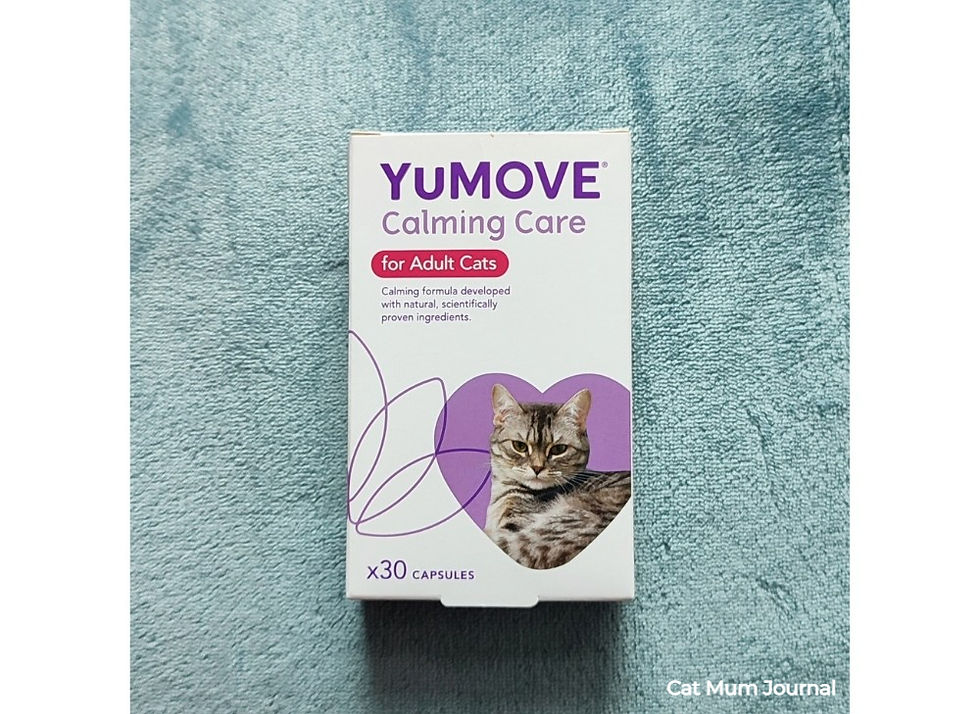 YuMOVE Calming Care contains natural ingredients to help reduce stress, anxiety and support calm behaviour. Easy opening capsules so powder can be sprinkled over food. |
You may have to wait for an appointment with a behaviourist, so you can use that time to gather information and make a note of any questions you have. Some veterinary practices are able to make referrals, or you can search independently online.
I recommend choosing someone local who can work hands-on with your cats and observe them in their natural environment. Although, having two wimpy cats of my own, I know this isn't always the best option! Most behaviourists will offer a phone or email consultation if it's more suitable.
All animal behaviourists should have professional qualifications and be recognised by a professional body, such as the Animal Behaviour and Training Council (ABTC).

The New Normal
"I want my cats to go back to normal and be happy."
Trust me, I get it. After several long months of Drax and Simba going back and forth between best friends and mortal enemies, I have nothing but empathy and understanding for parents going through the same thing. Which makes my final piece of advice so much harder....
There's every chance that your cats will return to a healthy relationship - or at the very least, learn to tolerate one another. In many cases, both my own and those of other parents that I've connected with, the fights will continue to erupt even after a successful reintroduction - albeit to a lesser degree.
Note that this only applies to cats that are able to live together. If the aggression is constant or there are other signs of anxiety or depression, you should keep cats separated and consult a vet or behaviourist for advice.
 Pet Remedy Calming Spray provides a natural way of tackling stress and anxiety in cats, dogs and other small animals. It contains a blend of valerian and essential oils and can be sprayed on bedding, blankets and carriers prior to a vet visit. |
My boys have come a long way in the last two years and are as close to "normal" as I could hope for; however, it is a new version of normality. By this, I mean there's still (and likely always will be) a very small level of distrust on Simba's part. Miscommunications do happen on occasion, but it's something I've learned to manage through trial and error.
It's a hard thing to accept and no one wants to hear it - in fact, it's likely worse for owners than it is for their cats! If this sounds familiar, it can simply mean that the dynamics of your cats' relationship has changed. Whether this is temporary or permanent will depend on your individual cats and circumstances.

While I agree that it's upsetting to see bonded cats not getting along, even if it's the odd scrap, we have to remember that they are cats. They do not live by the laws of human logic and are not obliged to like each other 100% of the time.
I used to have a neighbour with three indoor cats, and the more excitable male would torment the females to the point I could hear them screaming at each other through the walls. The next day, they'd all be hanging out together like nothing had happened!
Wild cats lead predominantly solitary lives or within colonies as a means of survival - something our domestic moggies don't have to worry about. Therefore, it's highly unnatural for a cat to share its territory with a housemate (even if they've been together for years without issue). The fact that they can live in any amount of harmony is, again, a big ask - not least after aggression has occurred.

A cat's survival instinct is some of the strongest in the animal kingdom. This instinct doesn't fade away simply because they're domesticated. In fact, for that switch to flip and completely change the personality of your cat, it should give you a good idea of how they're feeling internally.
Almost all of the cat parents I've spoken to with experience of aggression claim that, much like Drax and Simba, their cats are naturally skittish, timid or shy. It does seem to be a common denominator, particularly with cases of redirected aggression - in simple terms, when cats are easily "spooked" by external factors.
Loud noises, sudden movements and frightening events are common triggers for cats turning on each other. Unfortunately, this hyper-vigilance can become more prevalent after an aggressive episode, since cats will remember the trauma of their previous confrontation and apply it to the new experience - i.e., the loud noise.
A cat in fight-or-flight mode is often unable to think or react in a logical manner. Be vigilant, recognise the signs and act before you're forced to react. It's a good idea to have a separation plan in place, ensuring the set up of your home allows each cat to have its own space while they recover from their conflict. The sooner you can adapt to the "new normal", the easier everyone's lives will be.
To help you through the process, check out some of my kitty calming aid reviews and recommendations:
Mentioned Products
Fresh Pet Cleaner and Deodoriser
PELUOMOZ Cat Wall Furniture Set
Are your kitties at war or have you had a similar experience? Let us know in the comments if this article helped, and feel free to share any tips of your own!


Comments